The short version
- Preorders opened June 25, 2026; units have been shipping since late June
- $1,049 for 512GB, $1,349 for 2TB. With a Steam Controller bundled: $1,128 and $1,428. UK: £879 and £1,149
- CPU: semi-custom AMD Zen 4, 6 cores / 12 threads, up to 4.8 GHz, 30W TDP
- GPU: semi-custom AMD RDNA 3, 28 compute units, up to 2.45 GHz
- Memory: 16GB DDR5 system RAM plus 8GB GDDR6 dedicated VRAM
- Storage: 512GB or 2TB NVMe SSD
- Size: 156 × 162.4 × 152 mm, 2.6 kg — a small cube, not a console slab
- Runs SteamOS, not Windows
- Valve’s claim: “over six times the horsepower of Steam Deck”
- Measured 20–21 dBA under load — effectively silent
- Independent testing puts the GPU roughly in RTX 3060 / RX 7600 territory
Valve’s Steam Machine has been in people’s hands for about a month now, which is long enough to stop reading spec sheets and start asking the actual question: is a $1,049 living-room box from Valve worth it?
What it is
A small cube — 156 × 162.4 × 152 mm, 2.6 kg — running SteamOS on a semi-custom AMD pairing: a 6-core, 12-thread Zen 4 CPU up to 4.8 GHz, and an RDNA 3 GPU with 28 compute units. Unusually for this form factor it has dedicated VRAM (8GB GDDR6) alongside 16GB of DDR5, rather than carving a shared pool.
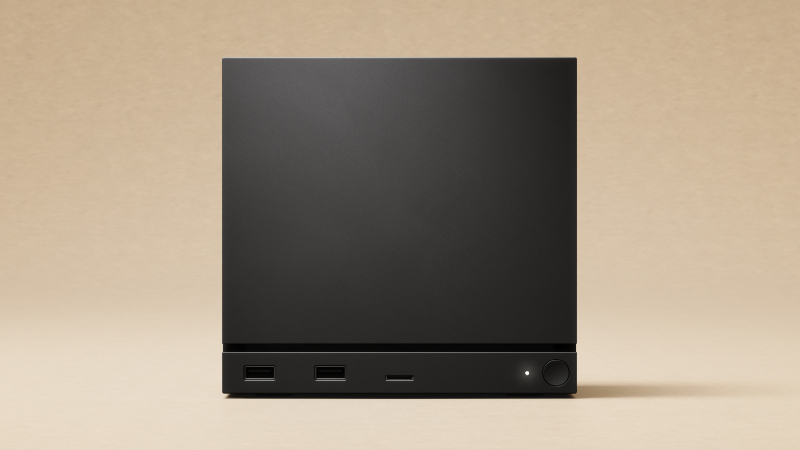
It is not a console. There’s no exclusive library, no separate storefront — it’s a PC that boots into Steam, plays your existing library, and stays out of the way. Valve also shipped a new Steam Controller alongside it, returning to the dual-trackpad layout and using a proprietary 2.4 GHz wireless link for roughly single-digit-millisecond latency.
What the performance actually looks like
Valve’s headline is “over six times the horsepower of Steam Deck.” That’s true and it’s also doing a lot of work, because the Steam Deck is a handheld. The more useful comparison from independent testing is that the GPU lands around RTX 3060 / RX 7600 — solidly mid-range desktop hardware from a couple of generations back.
In practice that means 1440p and 4K are upscaled, not native. The machine leans on AMD’s FSR to reach 4K60 from a 1080p render target, and heavy ray-traced titles push it hard — Indiana Jones and the Great Circle reportedly struggles to hold 40fps even on low settings.
The flip side is the thing spec sheets don’t capture: at 20–21 dBA under load it’s essentially inaudible, which for a box that lives under a TV matters more than a benchmark chart does.
The price question
$1,049 is the number people keep arguing about, and both sides have a point.
Against it: you can build a desktop with comparable or better raw performance for less, and a PS5 or Series X costs half as much. If frames per dollar is the metric, this loses.
For it: it’s tiny, silent, runs SteamOS rather than Windows (meaningfully more efficient on the same hardware, and no desktop OS to manage from a couch), and plays a library you already own instead of one you’d rebuy. Nobody else sells that specific combination.
Why it matters
Valve tried this in 2015 and it failed — the original Steam Machines were third-party boxes running an immature SteamOS with a Linux library that mostly didn’t exist. What changed in the decade since is Proton: the compatibility layer that the Steam Deck proved out at scale. This attempt has an actual working library behind it.
Whether it sells is a separate question from whether it works, and a month in the honest verdict is “it works, at a price that makes you think about it.” If you’ve been eyeing a couch PC and didn’t want to build one or babysit Windows, this is the first version of that idea Valve has shipped that actually does the job.
Sources: PCGamesN — Steam Machine release date, specs, and price, Vice — Steam Machine price and release date officially revealed, G2A News — Valve’s Steam Machine launch details: price, models, specs, and pre-order process, Tech Insider — Steam Machine: out now at $1,049